Have you ever felt overwhelmed trying to understand a complex system's structure? It can be frustrating to grasp how different parts of a system interact. But don't worry, there's a great solution! The SysML Block Definition Diagram (BDD) is here to help. 😊
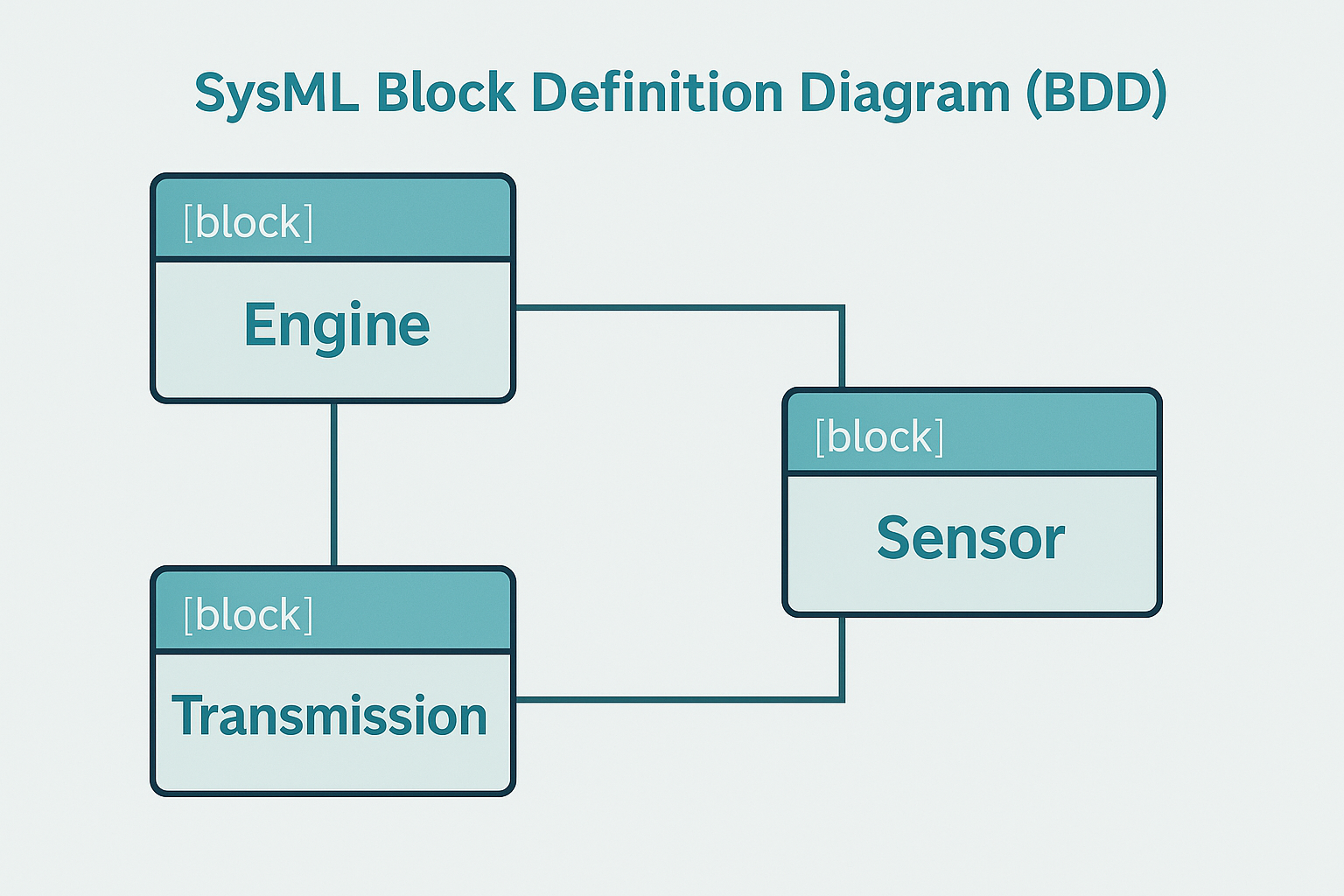
What is a SysML BDD? 🤔
A Block Definition Diagram (BDD) is a key tool in systems engineering. It helps us understand complex systems by showing their structure and how different parts are connected. These diagrams are especially important for clearly defining what each part, or "block," does and how it relates to others. In short, they effectively show the basic building blocks of a system and how they work together.
Main Model Elements of BDD 📊
BDDs have several main elements that help describe a system. Let's take a look at some of the most important ones:
- Blocks: These are the basic units of a system, representing physical parts or abstract ideas. Each block has a specific job.
- Actors: These are people or other systems that interact with the system. They help us see how the system connects to the outside world.
- Value Types: These define the types of data a system uses. This is important for making sure the system handles information correctly.
- Constraint Blocks: These represent rules or limitations that the system must follow.
- Flow Specifications: These define how data or energy moves through the system.
- Interfaces: These describe how different blocks interact with each other.
BDDs are used in many stages of a project, from analyzing what stakeholders need to developing test cases. They are a versatile tool for any systems engineer!
Structural Relationships in BDD 🔗
BDDs also show how different elements are related to each other. Here are the main types of relationships:
| Relationship | Description |
|---|---|
| Associations | Shows how two blocks are connected. For example, the link between an engine and a transmission. |
| Generalizations | Shows that one block is a special type of another. For instance, an "electric vehicle" is a special type of "vehicle." |
| Dependencies | Means that one element depends on another. If one changes, the other might be affected. |
When working with BDDs, it's important to understand the difference between a 'definition' (the blueprint of a block) and an 'instantiation' (a real-world example of that block).
Using BDDs with Enterprise Architect 📝
Tools like Enterprise Architect make it easy to create BDDs. You can create a block definition, like 'CAR', and then create instances of that block, like 'GV80:CAR'. This helps you model both the general structure of your system and specific examples of how it will be used.
Example: Creating a 'CAR' Block
- Create a 'CAR' block: This is the definition, or blueprint, for a car.
- Add the block to your BDD: Drag and drop the 'CAR' block onto your diagram.
- Create an instance: Drag and drop the 'CAR' block again, but this time, choose to create an 'Instance (Object)'. You can then name it something like 'MyCar:CAR'.
SysML BDD at a Glance
Frequently Asked Questions ❓
I hope this gives you a better understanding of SysML BDDs! They are a really useful tool for anyone working with complex systems. If you have any more questions, feel free to ask in the comments! 😊
This article is a re-reation of the core content of the article I wrote last year using AI. If you are interested in the original article, please refer to the HTML below!