Have you ever marveled, 'Wow, how do all these features come together and work so smoothly?' I often think that when I see the new features of the latest smartphones or cars. Someone must be responsible for orchestrating the entire process, from start to finish, for a complex system with countless intertwined parts and software. The unsung hero who plays that role is the 'Systems Engineer.' Today, we'll dive deep into this fascinating profession! 😊
Systems Engineers, The People Who See the Forest 🌳
It's not easy to define a Systems Engineer in one sentence, but I personally love the analogies of an 'orchestra conductor' or a 'chief architect of a building.' While individual musicians (developers, designers, etc.) focus on their parts, the conductor creates the harmony of the entire performance, right? Systems Engineers do the same.
They grasp the customer's requirements to draw the big picture of the entire system and manage the whole process to ensure each part connects smoothly, ultimately creating the amazing product or service the customer wants. It's not just a part of development; it's a crucial role that takes responsibility for the entire lifecycle of the system, from conceptualization, design, development, testing, and even to the final disposal phase.
In systems engineering, a development process called the 'V-Model' is widely used. It starts from the top left, analyzing requirements and detailing the design as you go down (the left side of the 'V'). Actual development happens at the bottom of the 'V,' and then you move up the right side, conducting tests that correspond to each design phase. Because you plan how to verify from the beginning, you can run the project much more systematically and stably!

What Are a Systems Engineer's Main Tasks? 📊
The 'conductor' or 'architect' analogy might not give you a concrete idea of what they do. Here is a table summarizing the main tasks of a Systems Engineer.
| Task Area | Detailed Description |
|---|---|
| Requirements Analysis & Management | Collects and analyzes requests from various stakeholders like customers, marketing teams, and executives to set clear development goals. |
| System Architecture Design | Designs the structure, or the 'skeleton,' of the entire system. Decides what role each subsystem plays and how they will interact. |
| Interface Control | Defines and manages the 'communication rules' so that features developed by different teams can connect without issues. |
| Integration, Verification & Validation (V&V) | Combines the developed parts and tests whether the system was built according to the design (Verification) and if it meets the customer's needs (Validation). |
| Risk & Issue Management | Proactively predicts potential technical risks or problems that may arise during the project and prepares solutions. |
Sometimes, when people hear 'Systems Engineer,' they think of a job managing company servers or networks. While those professionals are also excellent systems engineers, the Systems Engineer described today is a role from a product or service 'development' perspective. In other words, they are closer to someone who creates new systems.

In Which Industries Can You Find Them? 🚀
The concept of systems engineering actually originated from massive national projects like World War II and NASA's Apollo program. So, they have traditionally played a key role in fields like these:
- Aerospace & Defense: Developing systems that require extreme precision and stability, such as fighter jets, satellites, and missile defense systems.
- Automotive: Recently, their role has become crucial in the automotive sector, which involves numerous Electronic Control Units (ECUs) for autonomous driving, connected cars, and electric vehicles, where they are responsible for functional safety and cybersecurity.
- IT & Software: Large-scale cloud services, complex financial systems, Internet of Things (IoT) platforms, etc.
- Medical Devices: Ensuring the safety and reliability of devices directly related to human life, such as ventilators, MRIs, and surgical robots.
- Plant & Energy: Building and operating huge, complex facilities like power plants and semiconductor factories.
As products and services become more complex in almost every industry, the importance of Systems Engineers is growing ever greater.
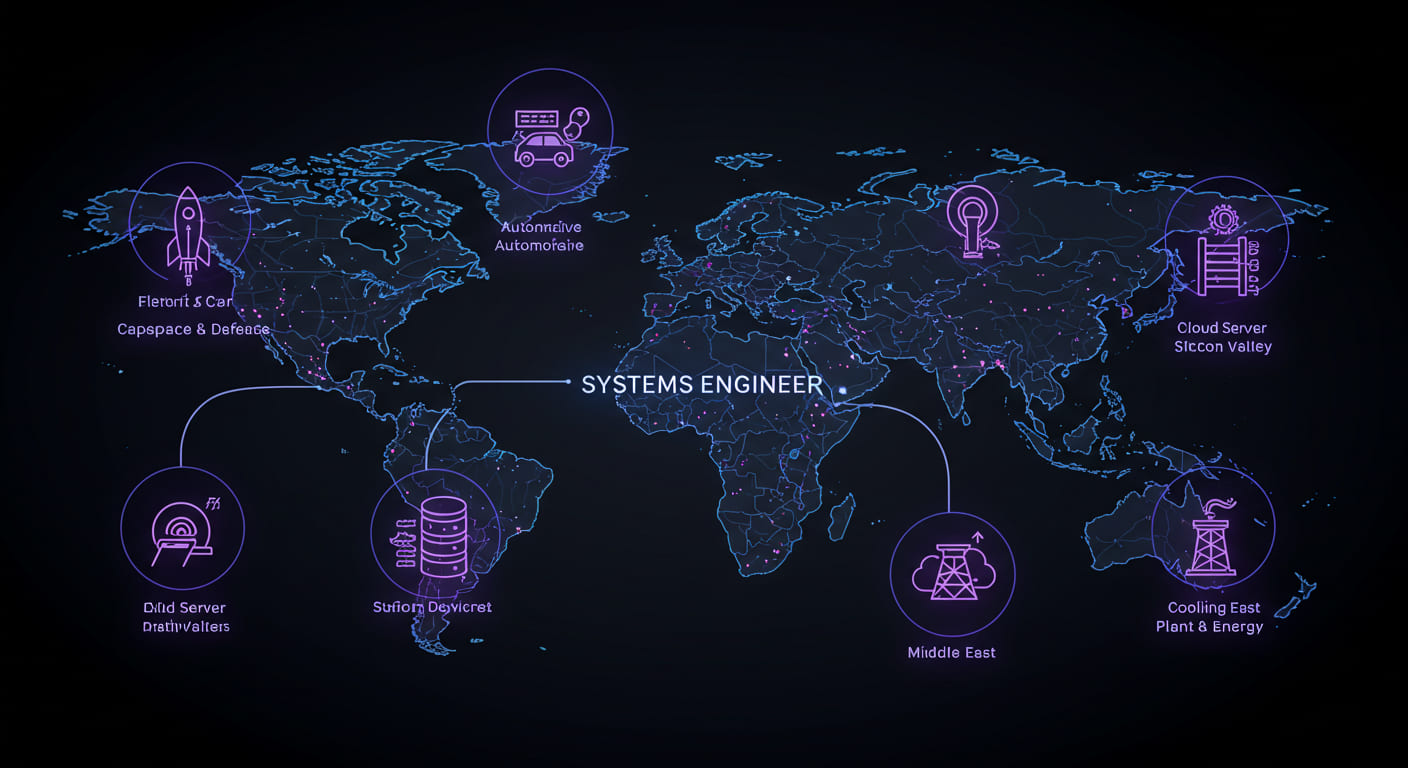
Systems Engineer at a Glance
Frequently Asked Questions ❓
So, what did you think about learning about Systems Engineers? I believe it's a very attractive profession where you get to collaborate with experts from various fields to create something grand. If you have any more questions, feel free to ask in the comments! 😊
This article is a re-reation of the core content of the article I wrote last year using AI. If you are interested in the original article, please refer to the HTML below!